

A truly memorable experience for the nearly 22,000 spectators at this year’s stadium show was entrée of the university’s wind ensemble. called Marching Band, as it made its way to the stage from the stands, marching around the arena floor. A similarly heartwarming moment of the night was the procession of more than a hundred international students carrying the flags of their respective countries. If you wish to recall the yoUDay experience, feel free to click on our videos!
News

A White Coat Ceremony was held for the first time at the Faculty of Medicine of the University of Debrecen on Saturday. At the end of the ceremony, more than three hundred third-year medical students donned the new white coats that symbolize the transition to preclinical and clinical studies. They also took a symbolic oath, pledging to pursue their studies with dedication and to apply the knowledge gained for the benefit of patients responsibly with empathy and humility.

The topics of the visit of the Ambassador of the Kingdom of the Netherlands to Hungary to the University of Debrecen were the opportunities for academic cooperation and exchange programs for tutors, researchers and students. Willem van Ee was received by Jenei Attila Vice-Rector for International Affairs.

At the University of Debrecen, more than a hundred and twenty newly graduated Hungarian and international students of the Faculty of Medicine took their Hippocratic oath and received their medical degrees and diplomas on Saturday. During the course of the ceremony, the freshly inaugurated physicians were also addressed by a former student of the faculty, medical futurist Bertalan Meskó, who drew their attention to how the new generation of physicians can efficiently use the opportunities offered by artificial intelligence in healing.
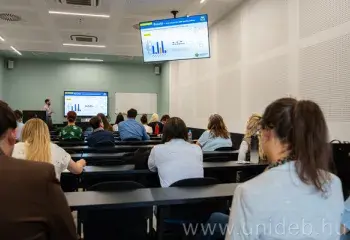
Several presentations were given on topics in pharmacology, pharmaceutical technology, pharmaceutical chemistry, and medical microbiology at the symposium of the Pharmacology and Microbiology Section of the Doctoral School of Medicine at the University of Debrecen. At the event held on Friday at the Faculty of Pharmacy, doctoral students reported on their scientific work and the results of their research to date.

Caroline Savage, Chargé d’Affaires ad interim at the U.S. Embassy in Budapest, and Gellért Gólya, agricultural attaché, learned about precision agriculture, water management, and international research collaborations during their visit to the Látókép Crop Production Experimental Station of the University of Debrecen. The American delegation was welcomed by Rector Zoltán Bács and Endre Harsányi, Vice Rector for Strategic Development.

The Faculty of General Medicine plans a transnational education programme in Israel. Students participating in the programme perform their studies in Israel and Debrecen according to the curriculum and syllabus of the Debrecen medical training program. After the completion of the training, the diploma is issued by the University of Debrecen. Within the framework of the project, a new university campus is established by the Israeli partners in Eilat who signed a memorandum of understanding recently with the university and faculty leaders of Debrecen.

A bile acid naturally present in the body (ursodeoxycholic acid) may contribute to the growth, spread, and metastasis of ovarian tumors, according to a study by researchers at the University of Debrecen. This finding is significant because previous studies on this substance had only demonstrated anticancer effects. The research highlights that substances produced by gut bacteria can affect different types of tumors in varying ways. The researchers have received the Publication Award from the University of Debrecen and the Count István Tisza Foundation for the University of Debrecen for their paper presenting these findings.

A form of vitamin D significantly reduced a dangerous inflammatory reaction associated with leukemia in laboratory studies, according to research by scientists at the University of Debrecen. This finding could lead to the development of new adjunctive treatments in the long term, but for now, vitamin D is not a substitute for life-saving steroid therapy. The researchers reported their findings in a prestigious international medical-biological journal, and their article has now been recognized with the Publication Award from the University of Debrecen and the Count István Tisza Foundation for the University of Debrecen.

More than 12,000 freshers are beginning their studies at the University of Debrecen as of this September. At the ceremonial senate meeting of the university on Sunday for marking the start of the new academic year, Minister for Education and Children’s Affairs Judit Lannert underlined that the future of Hungary is inseparable from the University of Debrecen, which serves as a model for other institutions of higher education in our country in so many respects. This year’s ceremony was also about honoring outstanding contributions to the reputation of our university. It was for the first time that titles of rector emeritus and decanus emeritus were conferred upon former leaders who have played a decisive part in the history of the institution.